
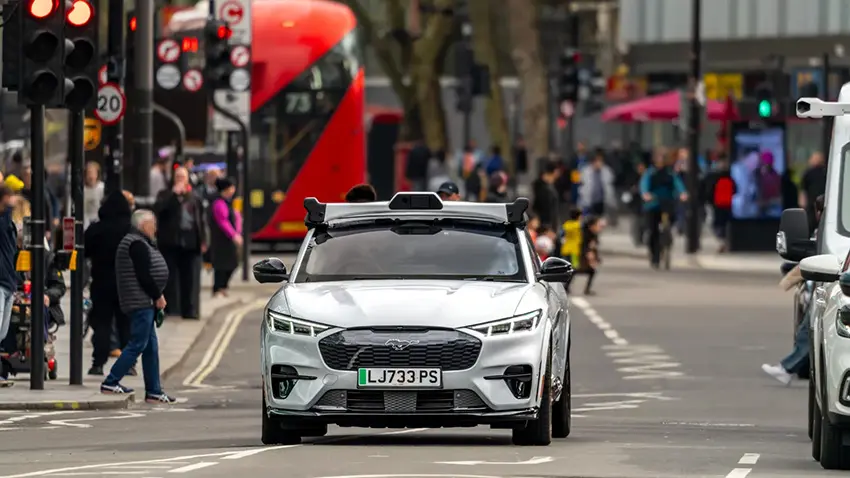
Around the world, the taxi business is slowly learning what it means when the driver is no longer human but a piece of software running inside the vehicle. In cities from Phoenix to Shanghai, pilot programs are starting to look less like science experiments and more like the beginnings of a real transport service. London is one of the latest places to join this shift, as regulators prepare trials where passengers will summon a car that arrives with no one behind the wheel. For city planners, the appeal is clear, robotaxis promise more consistent service and detailed data on how people move through streets. For traditional taxi drivers, they raise hard questions about jobs and professional identity.
In the U.S., Alphabet (NASDAQ: GOOGL) has spent years turning its Waymo unit into a commercial robotaxi operator, with paying passengers already riding in parts of Arizona and California. Chinese firms like Baidu are doing something similar in cities including Wuhan and Beijing. Until recently, Europe did not have an obvious local equivalent. That gap is where a British company called Wayve Technologies Ltd. now wants to play.
Wayve started in 2017 when two Cambridge researchers, Alex Kendall and Amar Shah, set out to see if an AI system could learn to drive a car using mainly cameras and data from real roads. Instead of building detailed maps and coding rules for every situation, they trained a single AI model to watch the road, decide on actions, and improve through experience. The company later moved to London and began running test vehicles on U.K. roads under human supervision. Over time, it showed the same software handling traffic in dozens of cities it had not seen before, an important proof that the approach could generalize beyond a single, carefully mapped area.
Rather than owning fleets of cars itself, Wayve sells its AI Driver as a software layer that automakers and fleet operators can integrate into their own vehicles. This model is attractive to taxi platforms such as Uber (NYSE: UBER), which already manage large networks of drivers and riders and now see an opportunity to swap some human drivers for autonomous vehicles over time. Wayve and Uber plan commercial robotaxi trials in London from 2026, with Uber operating the fleet and Wayve providing the driving brain.
To fund this shift from research to deployment, Wayve has raised significant capital. In February 2026, it secured about $1.2 billion in a Series D round that valued the company at roughly $8.6 billion. Investors included Microsoft, NVIDIA (NASDAQ: NVDA), Uber, and several global automakers. A follow on investment added another $60 million from Qualcomm (NASDAQ: QCOM), AMD (NASDAQ: AMD), and Arm Holdings (NASDAQ: ARM), three major chip companies that want their hardware to be a natural home for Wayve’s software.
For business readers trying to make sense of this, it helps to see how Wayve differs from the names that have dominated the robotaxi headlines so far. Waymo owns and operates its own branded service, controls its vehicles, and has poured money into high resolution mapping and sensor stacks tailored to its needs. Tesla (NASDAQ: TSLA) takes another route, using cars sold to consumers as the hardware platform for its Autopilot and so called Full Self Driving features.
Wayve’s bet is that carmakers and taxi platforms will want a third option. Instead of building a robotaxi business from scratch, or buying a closed stack from a rival, they can license a flexible AI Driver that works across different chips and vehicle types, then run the commercial service themselves. If that model works, a large part of the economic value could shift from owning cars and depots to owning the software layer that keeps vehicles moving safely and reliably.
For now, robotaxis are still a small slice of the global taxi market. The trials planned in London and Tokyo over the next few years will show whether passengers trust these systems, whether regulators stay comfortable with their safety record, and whether operators can make the numbers work once the cost of technology and maintenance is fully counted. The outcome will matter not only for Wayve, Waymo, and their investors, but also for anyone whose business depends on how people and goods move through cities.
