
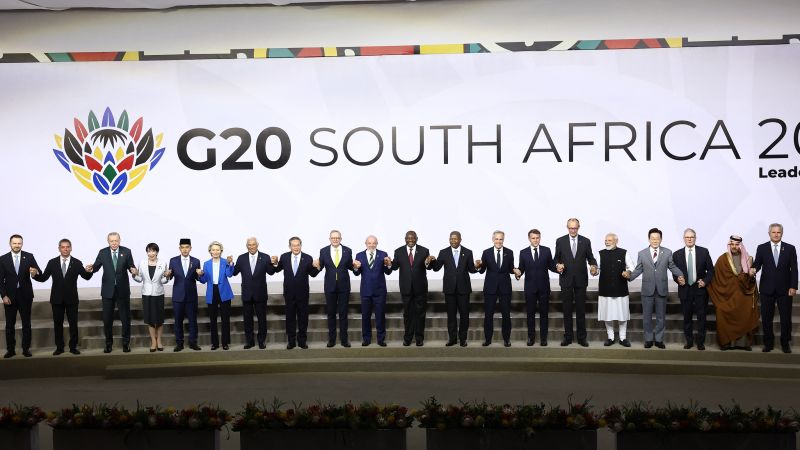
The G20 summit in South Africa this November was unlike any before, marked by the conspicuous absence of the United States. This decision, led by President Trump, follows his allegations that the South African government is mistreating its Afrikaner white minority and implementing policies he sees as discriminatory. These claims, despite being widely discredited, led the U.S. to boycott the gathering, disrupting the traditional unity that often characterizes these summits.
Before diving deeper into what unfolded, it helps to understand what the G20 actually is. The Group of Twenty, or G20, is an informal international forum founded in 1999 in response to global financial crises. It brings together 19 of the world’s largest economies along with the European Union and, more recently, the African Union. Originally, it was a platform for finance ministers and central bank governors to discuss international economic stability. Since 2008, heads of state and government meet annually to coordinate on critical global issues that extend beyond finance, such as climate change, sustainable development, trade, and health. The G20 countries collectively represent about two-thirds of the world’s population, nearly 85% of global GDP, and over 75% of world trade. Despite its broad membership, the G20 operates as a forum rather than a formal international organization, meaning it has no binding authority, but its discussions carry significant influence on national policies and global coordination.
The summit, held in Johannesburg, was the first G20 meeting hosted on African soil, a milestone intended to highlight issues often sidelined on the global stage. South African President Cyril Ramaphosa used the occasion to emphasize challenges faced by developing nations, including climate change resilience, reducing sovereign debt burdens, and tackling global inequality. The agenda had strong focus on supporting poorer countries, fostering renewable energy transitions, and ensuring that critical mineral wealth benefits host nations.
Despite the absence of the largest global economy, the remaining G20 members moved forward and broke with tradition by adopting a leaders’ declaration at the start of the summit. This 122-point document addressed many of the pressing concerns that weighed heavily on poorer countries, touching on climate-related disasters and debt relief initiatives. South African officials hailed this as a significant achievement for the continent as the summit’s host.
However, not all countries embraced this declaration uniformly. Argentina, under President Javier Milei, who shares political alignment with President Trump, chose to distance itself from the document and did not attend the summit in person. This stance reflected broader fractures within the group, illustrating that the boycott had ripple effects reaching beyond just the U.S. and South Africa. Nations like Germany, on the other hand, expressed support for the summit’s themes, praising the focus on sustainability and global solidarity.
The diplomatic tension between South Africa and the U.S. escalated towards the summit’s close when President Ramaphosa declined to hand over the G20 presidency gavel to a lower-ranking U.S. embassy official. South Africa viewed this as a slight, given the U.S. absence from the discussions. Normally, the summit concludes with the outgoing host passing the rotating presidency to the next country’s leader. But in this case, without any senior U.S. representative present, that tradition was disrupted and highlighted the depth of the diplomatic rift.
South African leadership maintained a firm stance throughout, signaling they would not be intimidated or coerced by the boycott. “Their absence is a loss for them,” Ramaphosa noted, underscoring that while the situation was challenging, it did not deter South Africa’s ambitions for the summit.
Other countries viewed the boycott through different lenses. China’s presence at the summit was significant, and some observers described the event as a quieter stage for emerging powers to assert influence amid the disengagement by the U.S. The summit proceeded with discussions on global economic recovery, climate efforts, and the energy transition, themes that the U.S. administration had previously dismissed as overly focused on diversity, equity, inclusion, and environmental policies.
The boycott shines a light on the growing polarization within international economic forums like the G20. What was meant to be a unifying platform for wealthy and developing nations became a stage for diplomatic confrontation. The U.S. choice to disengage from a key summit hosted by a strategic African nation also raises questions about its upcoming role as the next G20 president and how future summits might unfold under evolving geopolitical tensions.
For business professionals and global observers, the summit highlights how political undercurrents can shape economic cooperation. While the summit still produced actionable commitments, the absence of the U.S. casts a shadow on the cohesion and effectiveness of global problem-solving efforts, especially on issues like climate change and debt restructuring in developing countries. The G20’s future may depend on whether it can navigate these divisions or if the bloc will fragment into more regionally focused alliances.
