
Solar power has become one of the fastest growing sources of electricity in the world, but it comes with a simple physical demand: space. A large solar farm can spread across thousands of hectares, and in many countries the most suitable land is already spoken for by farms, housing and industry. Where open land does exist, it is often far from the cities that use the most power, which means building long transmission lines to carry the electricity to customers.
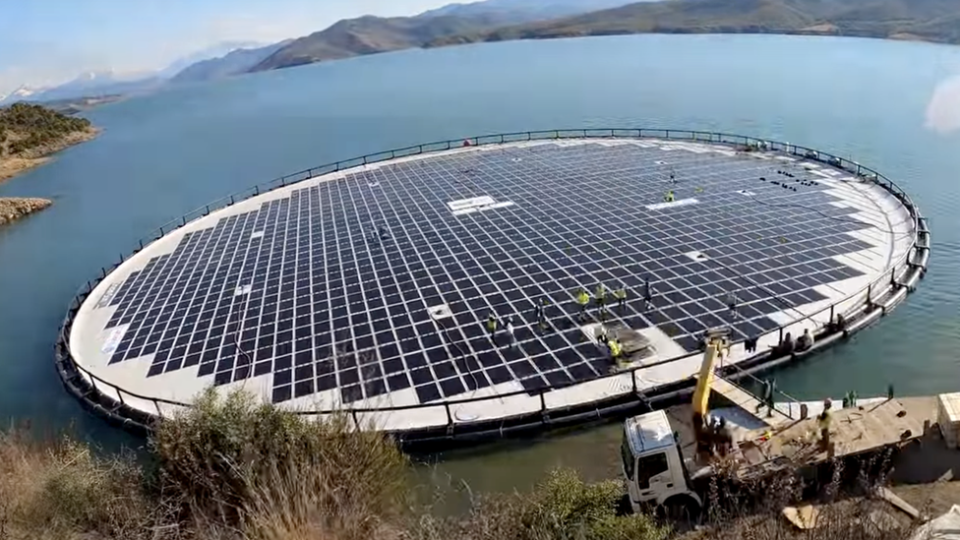
Developers have spent years working around that limit. Panels now sit on rooftops and parking structures, above crops and grazing animals in a practice called agrivoltaics, and on lakes and reservoirs as floating solar. Floating projects on fresh water have grown large, yet researchers have warned that the long-term effects of covering lakes with panels are still poorly understood, and some regulators have become cautious. Those concerns have pushed attention toward a far larger surface: the sea.
Offshore solar places panels on the ocean near the coast, close to the cities that need the power. There are two basic designs. Some projects float panels on rafts or membranes anchored to the sea floor. Others, in shallow water, mount them on steel platforms driven into the seabed. Supporters point out that cooler air and sunlight reflected off the water can lift output. Solar arrays can also be placed between offshore wind turbines and share their connection to shore, getting more energy out of the same patch of sea. Oceans of Energy, a Dutch developer, argues that solar on just 5% of the Dutch North Sea could meet half of the country’s energy needs.
The tradeoffs are real. Salt spray corrodes equipment, waves and storms batter structures, and in colder waters, winter brings sea ice. BloombergNEF estimates that building solar at sea costs about 40% more than on land, mostly because of complex installation and subsea cables. Unlike wind, which blows harder offshore, sunlight is not much stronger over water, so some analysts expect offshore solar to remain a niche.
Those doubts have not stopped China from building at a scale no one else has tried. About 8 kilometers off Kenli District in Dongying, Shandong province, stands HG14, a 1 gigawatt (GW) solar farm covering roughly 1,223 hectares of shallow sea. It was developed by Guohua Energy Investment, a unit of the state-owned China Energy Investment Corporation. It was built by China State Construction Engineering Corporation Limited (SHA: 601668.SS). The first panels fed power to the grid in November 2024, and the full plant was connected in December 2025. The reported cost is about $1.2 billion (CNY 8.1 billion).
The farm rests on 2,934 steel platforms, each 60 meters long and 35 meters wide, supported by 11,736 piles in water between one and four meters deep. More than 2.3 million panels are mounted on those platforms. Together they are expected to produce about 1.78 terawatt hours of electricity a year. That is enough for roughly 2.67 million urban residents and about 60% of Kenli District’s demand.
The platforms were designed to survive strong gales and winter ice, and the developer says the design uses over 10% less steel than earlier approaches. Power reaches shore through a 66-kilovolt subsea cable. It is the first time a solar project in China has used this kind of cable to move large amounts of power over a long distance. A battery system able to deliver 100 megawatts and store 200 megawatt hours helps smooth the flow of power into the grid. The developer also claims the plant generates between 5% and 15% more electricity than comparable plants on land.
The water beneath the panels is not wasted. HG14 follows a model of power above and farming below, with fish raised under the arrays. Huawei, which supplied the project’s inverters, estimates fish farming revenue at more than $4.1 million (CNY 27 million) a year. HG14 was also the first offshore solar project approved under a new Chinese framework that lets one area of sea serve several uses at once. One caveat matters, no independent study of its environmental impact has been published yet.
HG14 is not alone. In the Bohai Sea off Changli County in Hebei province, four state-owned companies are building a 1.8 GW project across about 17 square kilometers of water. The reported cost is about $2.2 billion (CNY 14.4 billion). Its first 500-megawatt section, built by Huadian, was connected to the grid in July. Industry estimates put China’s planned offshore solar capacity close to 100 GW.
Outside China, the scale is far smaller. In the Netherlands, Oceans of Energy installed what it describes as the world’s first offshore floating solar plant in 2019. It was a tiny 8.5-kilowatt system that came through several North Sea storms. Its newer floating array sits inside an operating offshore wind farm off the Dutch coast. SolarDuck is working with RWE Aktiengesellschaft (OTC: RWEOY) on a 5-megawatt system at another Dutch wind farm site, and has pilots planned in Tokyo Bay and Malaysia. HG14 is about 200 times the size of that RWE project.
The open questions are cost, the effect on marine life, and whether modest gains in output justify the extra effort of building at sea. China is testing those questions at full scale, while Europe is pairing small solar arrays with the wind farms it already has. As land near cities grows harder to find, the coastline is becoming a serious place to look for the next solar farm
