
Depression is one of the most common illnesses on the planet. The World Health Organization estimates it affected 332 million people in 2021, and it ranks as the second leading cause of years lived with disability worldwide. Together with anxiety, it costs the global economy roughly $1 trillion a year in lost productivity. For many patients, medication and talk therapy work. For a sizable group, they do not, and that gap has opened the door to a different kind of treatment.
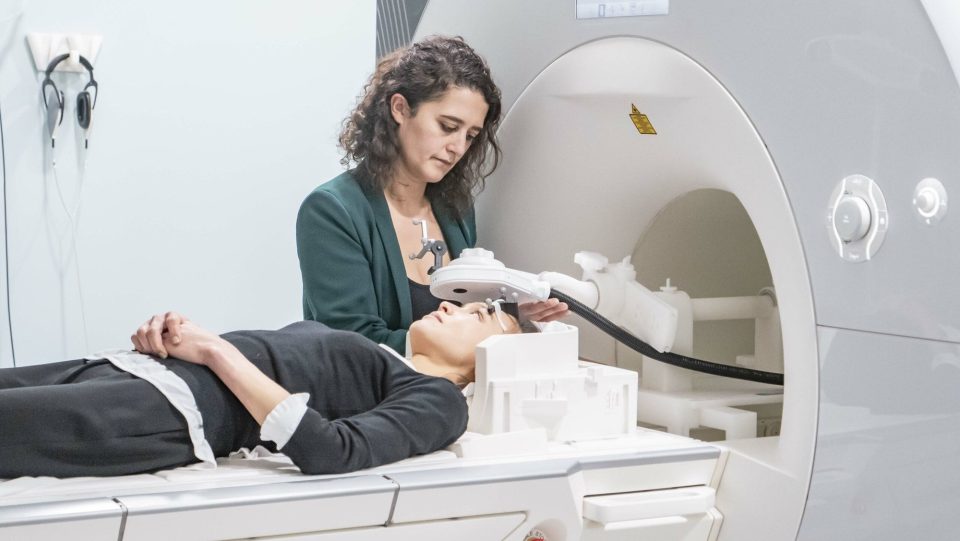
Transcranial magnetic stimulation, usually shortened to TMS, uses magnetic pulses delivered through a coil placed against the scalp. Those pulses create small electrical currents in targeted brain tissue, which can change how certain neural circuits behave. Patients stay awake, need no anesthesia, and can usually return to normal activities right after a session. The U.S. Food and Drug Administration first cleared standard TMS for major depression in 2008.
Early systems relied on a figure-8 coil, two flat loops of wire that focus energy on a narrow, shallow patch of the brain’s surface. Researchers at the National Institutes of Health wanted to reach deeper. They designed what became known as the H-coil, a three-dimensional coil that wraps around the head and pushes the magnetic field further into the brain without raising intensity to painful levels. That approach is called Deep TMS. It earned FDA clearance for medication-resistant major depression in 2013 and is now also cleared for obsessive-compulsive disorder (OCD) and smoking cessation.
The OCD clearance stands out. In August 2018, the FDA cleared Deep TMS for the condition after a double-blind, placebo-controlled trial run at multiple centers, giving patients with few options a non-invasive alternative. Research continues into other conditions, which could widen the pool of eligible patients over time.
The commercial market is still modest, but it is growing. Precedence Research valued the global TMS system market at $1.51 billion in 2025 and projects it will reach about $3.60 billion by 2035. Those forecasts depend on insurance coverage, clinician adoption, and continued evidence that the treatment works, so they are best read as a direction of travel rather than a promise.
One of the companies built around this technology reported its quarterly numbers today. BrainsWay Ltd. (NASDAQ: BWAY, TASE: BWAY), which developed its Deep TMS systems from the NIH H-coil and is headquartered in Jerusalem and Burlington, MA, said third quarter revenue rose 34% to $18.1 million.
The more telling part of the report sits below the revenue line. Operating income climbed 107% to $2.6 million, a margin of roughly 14%. Adjusted EBITDA, a measure of earnings that excludes interest, taxes, depreciation, and certain other charges, rose 92% to $3.9 million. Net income came in at $2.2 million, up from about $1.6 million in the same quarter last year.
When profit grows much faster than sales, as it did here, it usually means fixed costs such as research, sales staff, and administration are being spread across a larger revenue base. Analysts call this operating leverage. Each additional dollar of sales carries more of its weight through to the bottom line, as long as spending stays under control.
Cash is the other piece. BrainsWay generated $6.2 million from operations during the quarter and finished it with $63.4 million in cash and deposits. That matters because small medical device companies often spend years losing money. To keep going, many of them sell new shares, which shrinks the ownership stake of existing shareholders. This is known as dilution. A company that funds its operations from its own sales has less reason to raise outside money, although that can change if growth slows or a large new project comes along.
Deep TMS began as a research idea inside a government lab and has turned into a commercial treatment with a growing list of approved uses. BrainsWay’s latest results show that, at least for now, a company in this niche can grow quickly while paying its own bills. Whether that pace holds will depend on reimbursement trends, competition from standard TMS providers, and how many clinics choose to add the therapy in the quarters ahead.
