
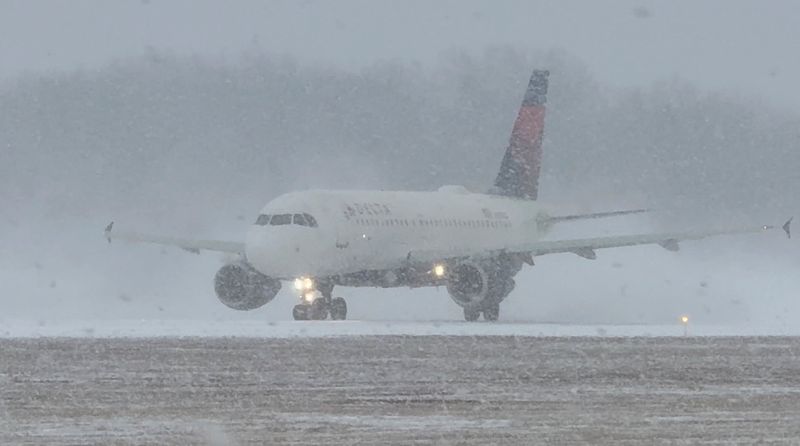
Across the United States, what was expected to be one of the busiest travel weekends of the year turned into a logistical challenge for airlines and passengers alike. A powerful winter storm swept across the Northeast on Friday, disrupting flight schedules, affecting major airports, and leaving travelers struggling to reach their destinations in time for holiday gatherings. By Saturday, more than 1,000 U.S. flights were canceled, following over 1,700 the previous day, according to data from FlightAware.
For airlines, this storm arrived at a crucial moment. American Airlines, Inc. (NASDAQ: AAL), Delta Air Lines, Inc. (NYSE: DAL), and Southwest Airlines Co. (NYSE: LUV) had prepared for record demand over the year-end travel period, increasing seasonal staffing and expanding schedules to handle what industry analysts forecasted as one of the busiest holiday travel seasons since before the pandemic. But the storm’s timing and reach, hitting major hubs along the Northeast corridor, left carriers scrambling to reassign crews, reposition aircraft, and respond to a surge of frustrated passengers.
Airlines moved quickly to reduce the damage. By Friday afternoon, the largest carriers had already waived change fees and fare differences for affected customers, allowing travelers to rebook without penalty. These policies, common during major weather disruptions, reflect a shift in airline strategy toward flexibility and customer retention. Still, the wave of cancellations rippled through the system, creating lingering disruptions that extended into Sunday and early Monday, even after the worst weather had passed.
Travelers took to social media to vent their frustrations and share their experiences. Some posted photos of crowded terminals and long lines at rebooking counters, while others praised airline staff for their efforts to manage reassignments amid the chaos. At airports like Boston Logan and New York’s LaGuardia, passengers described watching planes sit idle on tarmacs as crews waited for de-icing clearance. The mood ranged from weary resignation to relief for those who finally boarded delayed flights after hours of uncertainty.
Weather-related disruptions are not unusual during the winter holiday season, but this storm struck at a time when air travel demand remains high and network flexibility is limited. Carriers have gradually rebuilt capacity since the pandemic, yet staffing shortages in some areas and tight aircraft utilization rates leave little margin for error when storms roll in. According to the U.S. Department of Transportation, demand for air travel in December was already expected to surpass pre-2020 levels, putting pressure on airports and airlines to maintain reliability despite unpredictable winter weather.
By Monday morning, operations had begun to stabilize, though a few residual delays persisted in cities hardest hit by snow and ice. Airlines resumed most of their schedules as crews and aircraft repositioned across networks. Passengers whose weekend plans were derailed faced fewer cancellations, with only scattered regional interruptions remaining. Meteorologists forecast improving conditions across the eastern U.S. for the days leading up to New Year’s Eve, a relief for airports that had been strained by three days of intense weather-related management challenges.
For the industry as a whole, the weekend served as a reminder of how tightly synchronized air travel systems are. A single large weather event can ripple across an entire network, affecting aircraft rotation, crew scheduling, and passenger flow for several days. While advances in forecasting and digital scheduling have improved airlines’ ability to recover from disruptions, large-scale events like this one still test the limits of operational resilience.
Travelers and airlines alike are hoping that the worst is behind them. With the peak holiday season nearing its conclusion, attention now shifts to the coming weeks as carriers assess what worked and what did not. For passengers caught in the middle of the storm’s disruption, it was a memorable end to the year, though not the one they had planned.
