
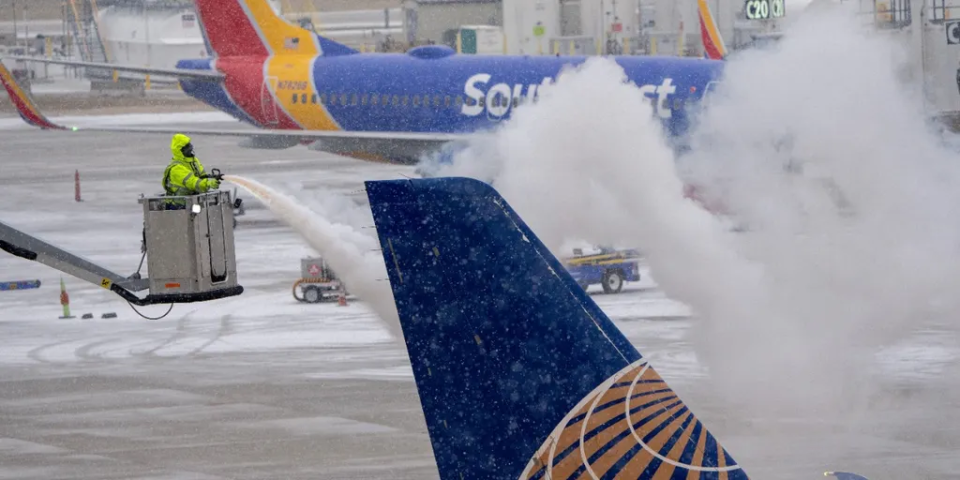
A winter storm swept across the United States over the weekend, blanketing much of the country in heavy snow and ice. This event led to thousands of flight cancellations, disrupting travel for countless passengers and businesses that depend on reliable air connections. Transportation Secretary Sean Duffy appeared on CNBC’s “Squawk Box” to address the situation, noting that air travel should return to normal by midweek.
The storm primarily hit the Midwest, Northeast, Southeast, and parts of the southern Great Plains. Areas like Dallas, Chicago, Philadelphia, and Washington D.C. saw the worst effects, with snow accumulation and freezing conditions making runways unsafe. Flight tracking data from FlightAware yesterday showed over 11,000 cancellations on a single day, marking one of the highest totals since the early pandemic years. For context, normal daily U.S. flight cancellations hover around 1% of 50,000 scheduled departures, so this spike overwhelmed airline operations.
Major hubs ground to a halt. Ronald Reagan Washington National Airport canceled 99% of its departing flights, while Philadelphia International scrapped 94% of its schedule. American Airlines faced over 1,400 cancellations, about 45% of its Sunday flights, and both Delta Air Lines and Southwest Airlines each cut more than 1,200. These numbers reflect a weekend total exceeding 14,100 cancellations since Saturday, with disruptions continuing into Monday as Duffy predicted.
Safety rules require airlines to deice planes and clear runways before takeoff, a process that slows down in extreme cold and ice. When storms dump accumulation faster than crews can manage, cancellations become inevitable to avoid accidents. The National Weather Service warned of heavy snow in the Northeast and gusty winds with frigid temperatures elsewhere, conditions that grounded aircraft across two-thirds of the country.
This storm echoed past events, like the January 2024 North American winter storm that delayed 335,000 flights and canceled 8,600 over four days. Airlines issued waivers allowing fee-free changes, but rebooking proved tough. With planes flying near capacity, little room exists to shuffle passengers, leaving many stranded overnight at airports from Dallas Fort Worth to Hartsfield-Jackson Atlanta.
For businesses, these cancellations mean more than delayed meetings. Supply chains falter when parts or executives cannot move, and perishable goods face spoilage risks. Companies in manufacturing or retail, reliant on just-in-time delivery, feel immediate pressure as flights carry high-value items that trucks cannot always replace quickly. The U.S. airline industry, handling about 80% of domestic passenger miles, underpins commerce worth billions daily.
Travelers endured long lines and hotel scrambles. People waited hours for accommodations after a connections vanished, a common story amid power outages in places like Michigan. Duffy’s assurance of midweek recovery offers hope, as warmer air and clearing skies should ease deicing by Tuesday or Wednesday. Airlines plan to ramp up once weather lifts, though backlogs may linger.
The Federal Aviation Administration had flagged risks days earlier for the Northeast and Mid-Atlantic, yet the storm’s reach surprised some southern areas unaccustomed to such severity. As operations normalize, carriers will analyze schedules to build in more buffer for future storms, a lesson from events like the 2024 CrowdStrike outage that canceled 3,600 flights in one day.
Business leaders watching this unfold know weather remains aviation’s wild card. Reliable travel keeps deals flowing and teams connected, so storms like this remind everyone to pack flexibility into plans. With Duffy’s timeline holding, the skies should clear soon, letting the nation’s travel engine rev back up.
