
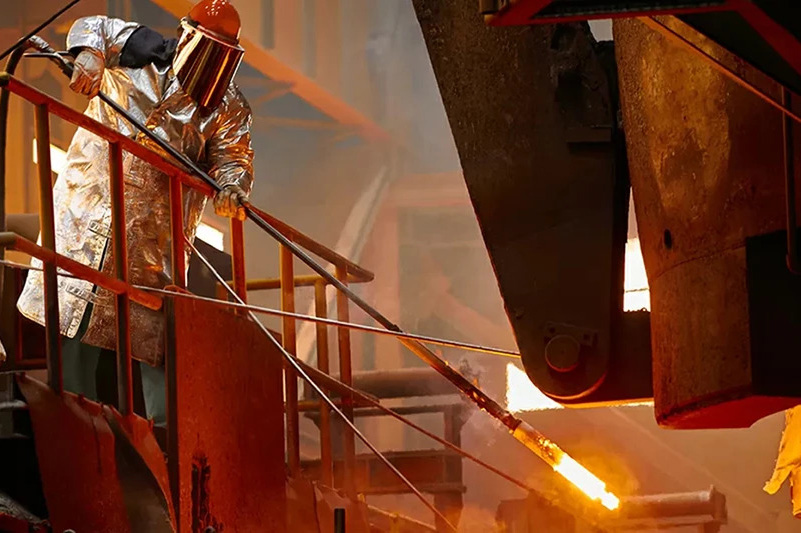
Most people picture recycling as a blue bin at the curb, but in the U.S. it is a heavy industry. Scrap yards buy old cars, appliances, demolition debris and factory offcuts, then sort, shred and bale them into feedstock that mills can melt again. According to the Recycled Materials Association, recycling businesses directly employ about 175,000 people, support more than 603,000 jobs in total and generate roughly $184 billion in economic activity each year.
Metal sits at the center of that trade. Steel is magnetic, easy to separate and can be remelted many times without losing its strength. U.S. mills and foundries consumed an estimated 57 million metric tons of iron and steel scrap in 2025, up from 55 million in 2024, and domestic scrap purchases were valued at about $19.7 billion.
The bigger shift is in how American steel gets made. Traditional mills turn iron ore and coal into steel inside blast furnaces. Electric arc furnaces melt scrap with electricity instead. The Steel Manufacturers Association says these furnaces now produce about 70% of U.S. steel, and a study it highlighted projects that share reaching 90% by 2040, supported by a domestic scrap reservoir of more than 4 billion tons.
That change has blurred the line between steelmaker and recycler. Nucor Corporation (NYSE: NUE), the country’s largest steel producer, also describes itself as North America’s largest recycler, processing about 20 million tons of ferrous scrap a year. Steel Dynamics, Inc. (NASDAQ: STLD) runs its own metals recycling business alongside its mills. Owning scrap supply gives these companies more control over their most important raw material.
Specialty producers sit at the other end of the scale, making smaller volumes of tougher, more precise alloys. Metallus Inc. (NYSE: MTUS), formerly known as TimkenSteel, is one of them. It melts recycled scrap in Canton, Ohio, to make alloy steel bars and seamless tubing for industrial, automotive, aerospace and defense, and energy customers. The company employs about 1,850 people and reported $1.2 billion in sales in 2025.
Metallus has reported that the Defense Logistics Agency, the logistics arm of the Department of War, had awarded it a contract with a five-year ordering period and a ceiling of $995 million. It also received a first delivery order worth about $125 million, and it has up to 24 months to fill each order.
This is an indefinite delivery, indefinite quantity contract at fixed prices, so the agency orders steel as it needs it. The $995 million is the most it can spend, not a commitment to spend it. The Department of War’s contract notice, published September 25th, identified the product as High Fragmentation 1 steel, or HF-1, the alloy used for the bodies of 155mm artillery shells.
Metallus has a market value of about $793 million, so the ceiling equals roughly 1.25 times the entire company. The first order alone is worth about 16% of that value and about 10% of 2025 sales. Because it can be delivered over two years, it works out to closer to 5% of sales per year.
The award also follows a physical buildout. On August 26th, Metallus and the U.S. Army commissioned a bloom reheat furnace, a roller furnace and supporting equipment in Canton, funded through a $99 million Army agreement to raise HF-1 output. At full capacity, the Army says, the site will make enough steel for more than 120,000 shell bodies a month.
Taken together, these steps point to a company moving from automotive and industrial cycles toward a longer relationship with a government customer, which is why some investors may start valuing it differently. The risks are real, though. Fixed prices can squeeze margins if scrap or energy costs climb, and the ceiling becomes revenue only if orders keep coming. Margin trends, backlog disclosure and follow-on orders will show how much of the headline number turns into sales.
Scrap has long been seen as the humble end of the metals business. In Canton, it is now the starting point for steel the military expects to need for years to come.
