
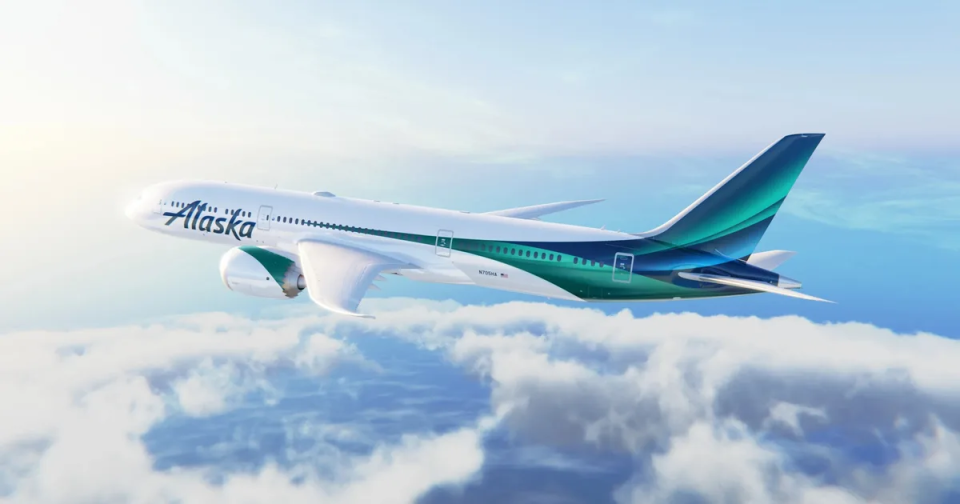
Alaska Air (NYSE: ALK) has announced a record purchase of 105 Boeing 737 Max 10 jets and five 787-10 Dreamliners in a deal that signals renewed confidence in Boeing (NYSE: BA). For Boeing, which has spent years trying to rebuild its reputation after multiple safety and production setbacks, the Alaska order represents more than just volume. It’s a public endorsement from a major U.S. carrier that has every reason to be cautious.
This order comes less than a year after a serious mid-air incident involving a blowout of a door plug panel on one of Alaska’s 737 Max 9 aircraft. While no one was killed, the event sharply reminded airlines and regulators that Boeing’s quality control had not yet escaped scrutiny. Since then, the company has worked under the close watch of the Federal Aviation Administration (FAA) and continues to make engineering, manufacturing, and communication changes meant to assure both regulators and airline customers that its processes are improving.
For Alaska, the choice to commit to Boeing again, and in such volume, is strategic. Aircraft deliveries are often scheduled many years ahead, and slots for new, large-scale aircraft orders are in high demand worldwide. By securing Max 10 and Dreamliner slots now, Alaska ensures a consistent pipeline of new aircraft through the mid-2030s. The decision helps the airline standardize much of its narrow-body fleet around a single family of jets, which can reduce maintenance complexity and training costs over time.
The 737 Max 10, however, remains uncertified. Boeing has faced repeated delays in gaining approval from regulators, with certification still pending as of early 2026. The Max 10 is the largest member of the 737 Max family and competes most directly with the Airbus A321neo, which has become the top-selling narrow-body aircraft in the world. In that sense, Alaska’s commitment to the Max 10 shows not only confidence in Boeing’s eventual delivery schedule but also a deliberate choice to bet on a domestic manufacturer in what remains a heavily competitive space.
From Boeing’s perspective, the order helps strengthen its long-term backlog and brings a psychological boost after a string of difficult years. The plane maker has wrestled with reputational challenges, supply chain disruptions, and frequent leadership turnover. An order of this magnitude, especially from an airline that experienced one of its most high-profile safety issues, helps project stability and renewed trust. Boeing’s executives have publicly emphasized operational discipline and safety as top priorities, but tangible repeat business like this does more to restore market credibility than any corporate statement could.
The timing is also important. Airbus remains the firm leader in the narrow-body market, with production goals exceeding that of Boeing’s 737 line. Yet Airbus’s long wait times have pushed many airlines to look for alternative sources, even if Boeing’s certification path still carries uncertainty. Alaska’s decision illustrates this dynamic clearly: for many carriers, getting guaranteed delivery slots through the 2030s is crucial, even if it means accepting short-term delays.
There is another angle to this deal that extends beyond aircraft. Alaska’s strategy demonstrates how airlines are preparing for steady, not explosive, growth after the post-pandemic travel recovery has largely normalized. By ordering proven models like the 737 Max and the 787 Dreamliner, the airline is investing in fuel efficiency and operational flexibility rather than gambling on untested designs. Boeing, in turn, benefits not only from immediate contract value but also from reinforcing its position as a long-term partner to key U.S. carriers.
If Boeing can successfully guide the Max 10 through certification and deliver on time, it stands to recapture some balance in the competition with Airbus. The real challenge, however, remains execution. Confidence from orders like Alaska’s can fade quickly if production lapses or safety issues reappear. For now, though, the deal gives Boeing a crucial narrative shift, one that suggests at least some major customers believe the company is heading in the right direction. That, in the airline world, may be just as valuable as the aircraft themselves.
