
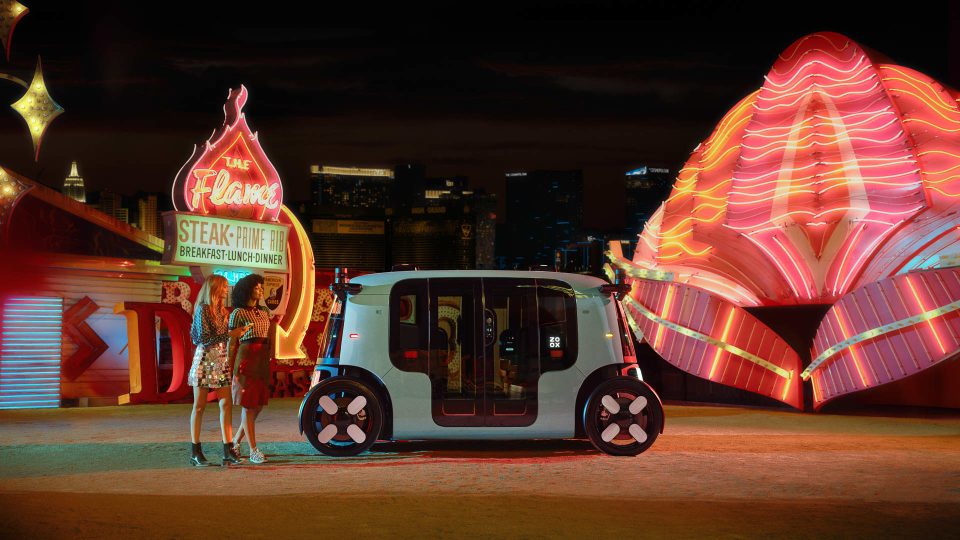
Amazon’s autonomous vehicle division, Zoox (NASDAQ: AMZN), has officially entered the U.S. robotaxi market by launching a public robotaxi service in Las Vegas. Starting in early September 2025, the service offers free rides from select locations in the city’s entertainment district, marking Amazon’s first move to compete directly with Alphabet’s Waymo, which currently dominates the space.
This step is notable as it is the culmination of five years of development and testing since Amazon acquired Zoox in 2020 for $1.3 billion. The Las Vegas rollout follows a period when Zoox’s robotaxis were only available to employees, then to their families and friends. Now, anyone with the Zoox app can request a ride to five predetermined destinations, including popular sites like Resorts World, the Luxor, and the New York-New York hotel. The rides cover up to about three miles per trip in vehicles designed to accommodate up to four passengers at a time.
Zoox is offering all rides without charge for the first few months to build awareness and user confidence in the safety of its self-driving cars. This approach is possible thanks to Amazon’s backing and plans to eventually start charging fares in Las Vegas that would align with prices charged by traditional taxis and ride-hailing services such as Uber and Lyft. However, final fare implementation currently awaits regulatory approval. The company sees the initial free ride period as an opportunity to collect valuable data and insights to improve the service before turning it commercial.
Zoox’s robotaxis stand out from competitors by employing a unique vehicle design that omits steering wheels and pedals. Industry observers commonly liken the shape of these vehicles to “toasters on wheels.” This design reflects Zoox’s philosophy that a purpose-built autonomous vehicle, not a modified conventional car, is the future of robotaxis. This contrasts with Waymo, which retrofits existing car models with self-driving hardware, maintaining a more traditional appearance. Zoox CEO Aicha Evans and co-founder Jesse Levinson have emphasized that building a robotaxi from the ground up allows for a superior and safer autonomous ride experience.
While Zoox has made public and operational in Las Vegas, it also operates in other U.S. cities including Austin, Texas, Los Angeles, Phoenix, and San Francisco, where it’s expanding its testing and early services. The company recently opened a purpose-built manufacturing facility near Silicon Valley in Hayward, California. This factory, spanning 220,000 square feet, is the first in the U.S. designed specifically for serial production of robotaxis. When fully ramped up, it aims to produce up to 10,000 robotaxis annually, far outpacing current production levels, which are around one vehicle per day.
Despite Zoox’s aggressive moves and Amazon’s financial muscle, Waymo remains the leader, having already provided over 10 million paid robotaxi rides across multiple cities. Waymo’s extensive experience and scale pose a significant hurdle for new entrants like Zoox. Tesla has also launched a limited robotaxi pilot in Austin, but their approach, which involves human oversight rather than fully driverless operation, differs.
In terms of regulatory challenges, Zoox’s lack of traditional driver controls means it must secure exemptions from U.S. auto safety rules, which typically require steering wheels and pedals. Talks with federal safety authorities and regulatory bodies are ongoing, with some optimism that these hurdles will be overcome in due course, aided by efforts from prior administrations to accelerate approvals.
Looking forward, Zoox plans to expand its service area within Las Vegas and other major urban markets in the coming months and years, gradually scaling up its commercial robotaxi operations. The stakes are high, as robotaxis represent a potentially transformative mobility solution that could reshape urban transportation and reduce dependence on human drivers.
Amazon’s bet on Zoox reflects a broader industry shift toward autonomous mobility, supported by advancements in artificial intelligence, sensor technology, and vehicle design. While the path to widespread adoption remains complex, Zoox’s Las Vegas service launch is a major milestone that signals Amazon’s serious commitment to this new frontier and provides a fresh option for consumers willing to try a fully driverless ride.
