
[stock_market_widget type=”card” template=”basic2″ assets=”AAL” realtime=”true” api=”yahoo-finance”]
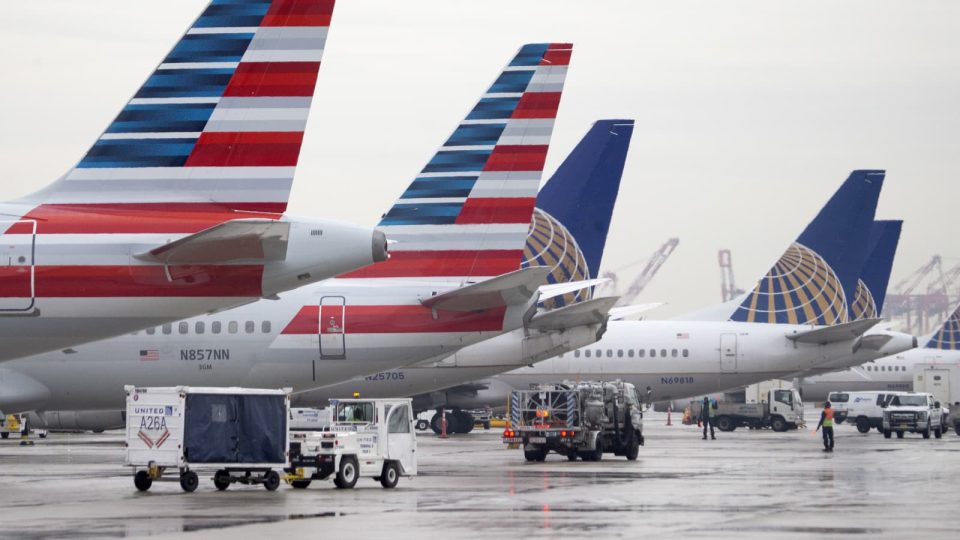
American Airlines Group Inc. (NASDAQ: AAL) shares dropped 5% today after the company dismissed rumors of a merger with United Airlines (NASDAQ: UAL). The news came on the heels of a statement Friday where American made clear it saw no path forward for such a combination. Investors reacted swiftly to the rejection, sending the stock lower as hopes for a mega-deal evaporated.
Talk of this potential union did not emerge overnight. It traces back to late February 2026, when United’s CEO Scott Kirby reportedly discussed airline consolidation ideas during a meeting with President Trump. Whispers picked up steam in early April about antitrust worries and fare hikes if the deal happened. At that point, airline stocks saw some volatility, though nothing dramatic until American’s firm no last week.
To understand why this matters, consider the scale. American holds about 21% of the U.S. domestic seat market, making it the largest carrier by that measure. United follows close behind at around 19%, with both part of the “Big Four” that control roughly 75% of the market alongside Delta and Southwest. A merger would combine them into a behemoth with over one third of domestic capacity, dominating key routes and hubs like Chicago’s O’Hare, where they already battle fiercely.
Such dominance raises red flags for regulators. American explicitly cited antitrust risks and harms to competition in its rejection, adding that the idea would hurt consumers too. Critics agree a combined entity could push fares higher by reducing choices on hundreds of routes. Travelers might face fewer options and steeper prices, especially on busy East Coast and transcontinental paths. This echoes long standing concerns in an industry where four players now handle what ten did decades ago.
History backs that worry. U.S. regulators have blocked airline tie ups before to protect competition. In 1960s and 1970s cases, the Civil Aeronautics Board stopped mergers that threatened market balance. More recently, a 2001 attempt by United to buy US Airways fell apart under Justice Department scrutiny over slot control at Reagan National Airport. The department worried about curbing low fare rivals. Then in 2013, the DOJ sued to halt American’s merger with US Airways, settling only after the airlines gave up slots and gates at constrained airports like LaGuardia and National. Just two years ago, a judge killed JetBlue’s bid for Spirit over similar issues, marking the first full block in decades and signaling tougher enforcement.
American’s stance aligns with that regulatory reality. Even under a pro business administration, combining the top two carriers seems a bridge too far. The company emphasized Friday that such a move would face steep hurdles from bodies like the Justice Department and Transportation Department. Kirby’s chat with Trump fueled speculation, perhaps hinting at friendlier merger reviews, but American saw the pitfalls clearly. No formal offer ever materialized, just informal soundings that went nowhere.
Markets shrugged off early merger buzz but punished today’s news. Before the drop, American traded around recent highs amid solid travel demand into 2026. United dipped too, though less sharply, as investors weighed the lost growth story. Analysts note airlines already grapple with high fuel costs, labor deals, and capacity limits. A merger might have promised efficiencies like shared routes and fleets, but at the cost of scrutiny that could drag on for years.
For passengers, the status quo holds. Competition among the Big Four keeps pressure on prices, even if bags fees and extras add up. American and United will keep adding flights, like American’s 30% schedule boost at O’Hare for spring 2026. Rivals like Delta gain breathing room without a new giant looming. Watch for earnings this week, where fuel prices and bookings will dominate talk over dead merger dreams.
This episode shows how even bold ideas hit turbulence in a consolidated sky. Airlines chase scale, but watchdogs guard the gate.
