
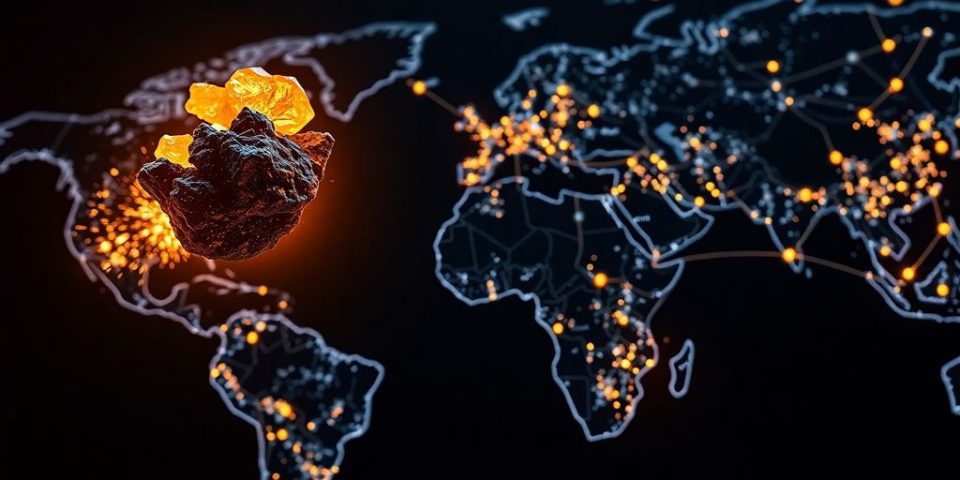
Rare earth minerals might sound like the stuff of niche science, but every time you hit the brakes in your electric car or track your location on a smartphone, you’re relying on materials that have become a lightning rod in global politics. At the heart of an escalating U.S.-China trade showdown, rare earth elements have proved to be China’s greatest bargaining chip, sending manufacturers scrambling and U.S. officials racing to shore up alternative sources.
China currently mines just about 70% of the world’s rare earths and processes roughly 90% of them, giving it dominance over a cluster of 17 elements that are essential for everything from wind turbines and smartphones to fighter jets and electric vehicles. And in a world where high technology is central to economic as well as military power, whoever controls rare earths holds serious leverage.
Earlier this year, China decided to flex its muscles. In response to a new wave of sweeping tariffs from the U.S., Beijing imposed export controls on seven rare earth elements and associated magnets, meaning companies had to obtain special licenses to export these critical products. That set off disruptions almost instantly, especially as Chinese customs data showed a 37% plunge in rare earth shipments to the U.S. in April, and a 58% drop in rare earth magnets over the same period. For manufacturers, particularly in the auto sector, the move wasn’t just a paper headache. Some were reportedly on the verge of stopping production lines altogether as supplies dwindled, a testament to how tight these markets are.
While temporary trade truces and high-level negotiations managed to produce a framework agreement with China, the actual specifics remain ambiguous, and U.S. dependence on Chinese supply has not fundamentally changed. Even now, heavy rare earths mined in California often still make their way to China for final processing, simply because the U.S. lacks the specialized capacity to do so itself. So the vulnerability isn’t just theoretical; it’s being tested in real time.
The U.S. has known about this weakness for more than a decade. Spooked by China’s use of rare earth leverage against Japan in 2010, American officials pumped money into reviving domestic mining. The result: the U.S. is now the world’s number two rare earth miner, thanks mostly to MP Materials (NYSE: MP) at its Mountain Pass site in California. Still, until recently, most of the processing and all of the heavy rare earth separation happened overseas, almost always in China.
Change is underway, but the ramp-up isn’t as quick as anyone would hope. The U.S. government has committed over $400 million to MP Materials for new magnet manufacturing and has used the Defense Production Act to jump-start other domestic projects. Just this month, the U.S. Department of Defense took an equity stake in MP Materials, making the Pentagon the company’s largest single shareholder, as part of a push to ensure supply for defense uses like fighter jets, submarines, and advanced missiles. The goal is to produce enough magnets within U.S. borders to meet American demand, but at best, that will take several more years to fully realize.
Officials have stopped pretending that tax incentives or tariffs alone will solve the problem. Instead, the U.S. is accelerating efforts not only at home, but also by seeking supply and partnerships in allied countries such as Australia and even exploring options in Central Asia and Ukraine. Meanwhile, the G7’s new Critical Minerals Action Plan aims to coordinate Western supply chains, establish stronger pricing systems, and ramp up investment in strategic mining and processing facilities worldwide.
As global demand for rare earth magnets is expected to more than double over the next decade, U.S. companies face a gnawing question: can domestic supply scale up in time to ensure security and stability, or will American industry continue to operate at the mercy of Chinese exporters? For now, rare earths remain China’s ace in the ongoing high-stakes game of economic chess, and the scramble to rebalance that power dynamic is only just getting started.
