
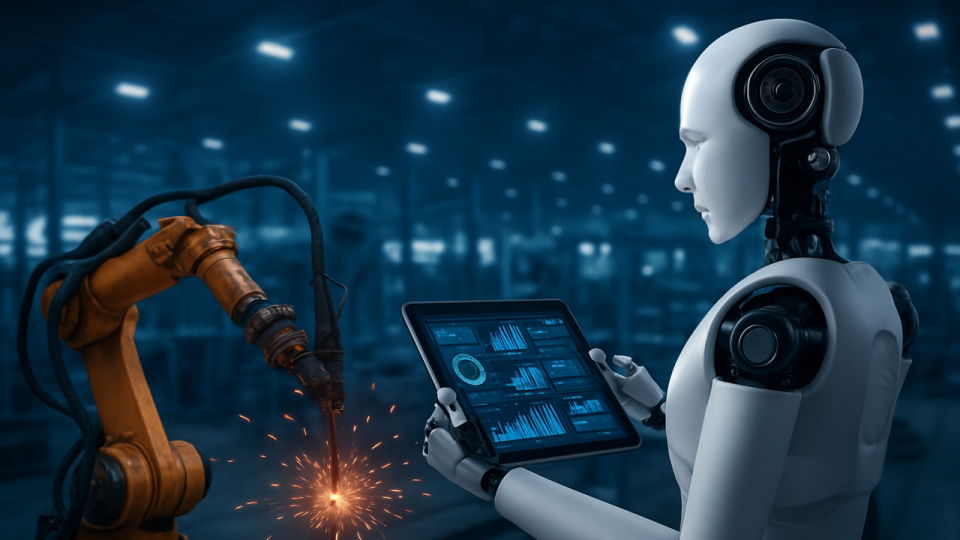
In manufacturing, the sound of progress has always been mechanical. From steam power to assembly lines, from microchips to artificial intelligence, the evolution of how we make things reflects the world’s changing relationship with efficiency and skill. Today, another shift is taking shape: the spread of robotics across nearly every sector of production.
Factories producing electronics, automobiles, packaging, and even food have begun turning to intelligent machines capable of learning, coordinating, and adapting to their environments. Robots are no longer limited to monotonous motion or single-purpose welding. They now handle inventories, quality checks, and precision tasks where human fatigue or hazard once dominated. According to the International Federation of Robotics, global installations of industrial robots reached more than 590,000 units in 2023, an increase of nearly 8% from the previous year. Analysts expect the total number of operational industrial robots worldwide to cross 4 million units by 2026.
While Asia has long led robotic adoption, driven largely by China, Western manufacturers are accelerating their own transitions. Rising labor costs, ongoing supply disruptions, and the availability of smarter automation systems have encouraged companies to rethink the balance between people and machines on the factory floor. The automotive industry, traditionally a bellwether for industrial technology, remains the most visible testing ground for this change.
Hyundai Motor Group (KRX: 005380) recently confirmed plans to deploy humanoid robots at its U.S. manufacturing plant in Georgia starting in 2028. The company said the machines will perform tasks that are repetitive or physically demanding, with the goal of reducing workplace risk and increasing overall productivity. These humanoid robots, built through Boston Dynamics, which Hyundai acquired in 2021, resemble human workers in size and movement but are designed to collaborate with people rather than replace them.
Automotive assembly lines have long relied on mechanized arms and guided systems, but humanoid forms represent something more profound. An autonomous robot capable of navigating spaces, understanding environmental cues, and making simple decisions begins to blur the traditional line between human and mechanical labor. Industry observers note that this shift is not only about technology but also about redefining the idea of a “worker” inside industrial ecosystems.
Economically, the rationale for robot deployment centers on cost and consistency. Robots do not require rest, insurance, or re-training. However, the upfront expense and integration period remain challenging for smaller manufacturers. The average price of a collaborative industrial robot still runs between $25,000 and $45,000 USD depending on complexity, maintenance requirements, and programming needs. Over time, these costs are expected to decline, similar to how early computers transitioned from laboratory curiosities to everyday tools.
Analysts at McKinsey & Company suggest that robotics could contribute as much as $1.4 trillion to global manufacturing output annually by 2030 through productivity gains and quality improvements. At the same time, the global robotics market, valued at roughly $42.5 billion USD in 2024, could more than double by 2030 if demand for automation in logistics and electronics continues to rise. The question for businesses is no longer whether to automate, but how much of their production chain to assign to machines that think, move, and respond.
For Hyundai, integrating humanoid robots is both a statement of intent and a test of practicality. Georgia’s automotive plants serve as important export and innovation hubs for the company’s North American operations. By bringing robots into that environment, Hyundai is signaling a commitment to long-term human-machine collaboration where safety, efficiency, and adaptability share equal priority. Workers are expected to transition toward oversight, maintenance, and system management roles, reinforcing the idea that future factories may look less like rows of welders and more like orchestras of coordinated intelligence.
The rise of robotics in manufacturing does not represent a future takeover, but rather a broad evolution in how work is defined. Whether assembling vehicles in Georgia, chips in Taiwan, or packaging goods in Germany, machines are learning to share the workspace with people. The coming decade will not be remembered for factories that became empty, but for those that learned, through robotics, to balance precision with partnership.
