
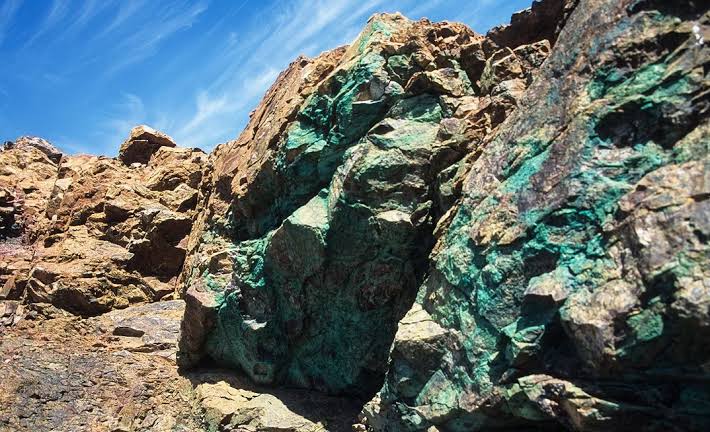
Copper has been dug out of Namibian soil for a very long time. Archaeologists have found evidence of copper smelting near the site of today’s Matchless Mine that is more than 400 years old, and industrial mining took hold at Tsumeb in 1906.
That legacy faded over time. The Tsumeb Mine closed in the 1990s after its ore ran out, and by 2023 the Otjihase, Matchless and Tschudi mines were all listed on care and maintenance. Even the downstream side has struggled. The Tsumeb smelter, one of the few plants in the world able to handle concentrate laced with arsenic and lead, paused copper smelting in June 2025 because it could not secure enough feed. It produced about 33,000 tonnes of copper in 2024.
The picture is now changing, largely through restarts of old operations. Construction to reopen the Kombat Mine in central-north Namibia began on February 6th, with production targeted for the fourth quarter and a steady state of up to 60,000 tonnes of ore a month. Consolidated Copper Corporation plans to restart the Otjihase and Matchless underground mines in October 2027 and expects more than 23,000 tonnes of concentrate in 2028.
New money is arriving too. On May 14th, private equity firm Appian Capital Advisory bought 95% of the Omitiomire project northeast of Windhoek and said it would need about $400 million to build a mine producing roughly 30,000 tonnes of copper a year for 15 years. These are meaningful projects, but they are mid-sized. None of them would place Namibia among the world’s larger copper producers.
A much bigger proposal arrived today. Koryx Copper S.A. (OTCQX: KRYXF, TSXV: KRY, NSX: KYX), a Luxembourg-based developer, published a pre-feasibility study (PFS) for its wholly owned Haib Copper Project in southern Namibia, about 6 kilometres north of the South African border. A PFS is the middle stage of mine planning: more detailed than an early estimate, but not yet the final engineering study that lenders rely on.
The study describes an open-pit mine processing 48 million tonnes of ore a year over a 24-year life. It projects about 135,000 tonnes of copper in concentrate annually during the first 10 years, which works out to roughly 130,000 tonnes of payable copper, meaning the share the company actually gets paid for. Over the full life of the mine, payable output averages about 105,000 tonnes a year. Using a flat copper price of $5.00 per pound, the after-tax net present value is $2.5 billion and the after-tax internal rate of return is 25%, with payback in 3.9 years.
The catch is the price tag. Upfront construction capital is estimated at $2.06 billion, including $133 million of contingency, plus $639 million of sustaining capital over the life of the mine. That is several times the company’s stock market value. Chief executive Heye Daun said earlier this year that a project of this size is too large for a junior to finance and build on its own.
The company is targeting a definitive feasibility study in 2027, along with a mining licence and environmental clearance by the middle of that year. A strategic options and project financing review is also planned for 2027. Notably, the PFS economics assume no streaming deal or offtake prepayment, so those funding tools remain available for any eventual package.
Haib now has the scale that larger miners and metal traders tend to notice, in a country trying to rebuild its copper industry. Whether that interest arrives as a joint venture partner, an outright buyer, or a mix of debt and offtake funding will decide how much of the project’s value existing shareholders keep. The geology question has largely been answered. The financing question is the one still open.
