
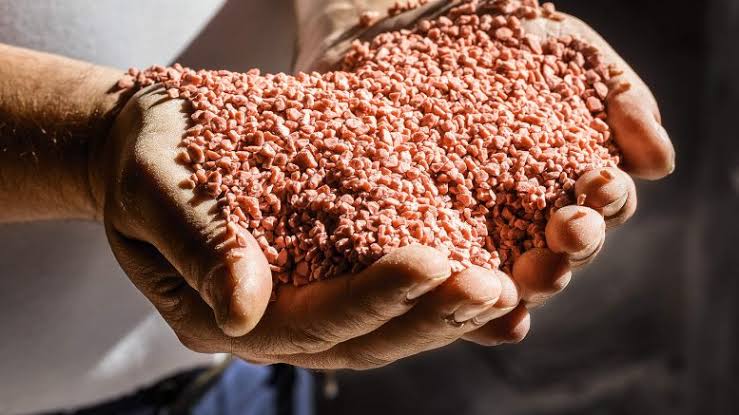
Fertilizer spread on a cornfield or rice paddy usually carries three core nutrients, and potassium is one of them. Potash is the catch-all name for the potassium-bearing salts mined to supply it, and agriculture has no substitute for it. Most of it comes from deep salt beds left behind when ancient inland seas evaporated. The U.S. Geological Survey estimates global mine output at about 49 million tons of potassium oxide equivalent in 2025. Supply is concentrated: Canada, Russia and Belarus together produced about 70.5% of the 2024 total, which is why potash comes up in conversations about food security, not just mining.
Canada sits at the top of that list. The USGS estimates Canadian mines produced about 15 million tons of potassium oxide equivalent in 2025, roughly 31% of world output, up from 14.4 million tons the year before. The country also holds the world’s largest reserves, at 1.1 billion tonnes. Potash sales climbed more than 18% in 2025 to about $6.5 billion (CAD $9.3 billion), according to the Saskatchewan government. Canada is the biggest exporter as well. The most recent full-year figures from Natural Resources Canada show about 22.9 million tonnes shipped in 2024, more than 39% of world exports, with the U.S. taking 53%. The USGS says Canada supplied 79% of U.S. potash imports between 2021 and 2024.
Nearly all of that activity happens in one province. Saskatchewan hosts every operating potash mine in the country and sits on the Prairie Evaporite Deposit, the largest known potash formation in the world. Crews drilling for oil found it in 1943, and the province now has 11 active mines, with most deposits lying between 2,500 and 3,000 feet underground.
Four companies produce all of Canada’s potash. The biggest names are Nutrien Ltd. (NYSE: NTR, TSX: NTR), The Mosaic Company (NYSE: MOS) and German fertilizer group K+S Aktiengesellschaft (OTC: KPLUF). Mosaic’s Esterhazy operation is considered the largest potash mine on the planet.
Producers recover the mineral in one of two ways. Conventional mines send crews and machines underground to cut the ore. Solution mines pump fluid down wells to dissolve the potash, then bring the brine back to the surface for processing.
That is the backdrop for today’s news from Buffalo Potash Corporation (OTC: BLPTF, TSXV: BUFF), an early-stage developer building its first small production module at the Disley project, about 50 kilometers northwest of Regina. The property sits beside K+S’s Bethune solution mine and north of Mosaic’s Belle Plaine solution mine. The company released lab results from two wells drilled this summer. The Source Well cut 20.5 meters of potash-bearing rock grading 39.4% potassium chloride, and the Disposal Well, about 1,600 meters east, returned 16.2 meters at 32.6%. The layer that will host Buffalo’s first mining zone measured 5.5 meters at 36.9%.
These wells were not drilled to explore. Their job is to move brine for the module, and the company cored them on the way down, adding two modern data points at no extra drilling cost. Chief executive Steve Halabura said every well at Disley “now does double duty.” All five module wells are drilled, equipping is underway, and first production from the 125,000 tonne per year module is targeted for the first quarter of 2027.
The longer-term plan rests on a preliminary economic assessment released May 22nd. It outlined output of up to 1,125,000 tonnes a year from three facilities, with an estimated after-tax net present value of $1.1 billion and a 30% internal rate of return. Buffalo plans to update that study with the new data, which could also reflect Canada’s proposed Productivity Mega Deduction, announced September 15th but not yet enacted.
None of this removes the risk. Buffalo has no mineral reserves, its decision to build is not backed by a feasibility study, and its patented Horizontal Line-Drive mining method has never run at commercial scale. What the results do show is high-grade rock sitting right where the first mining zone is planned, in one of the few regions on earth where potash is mined at scale.

How One Presidential Comment Made Gold Prices Surge